
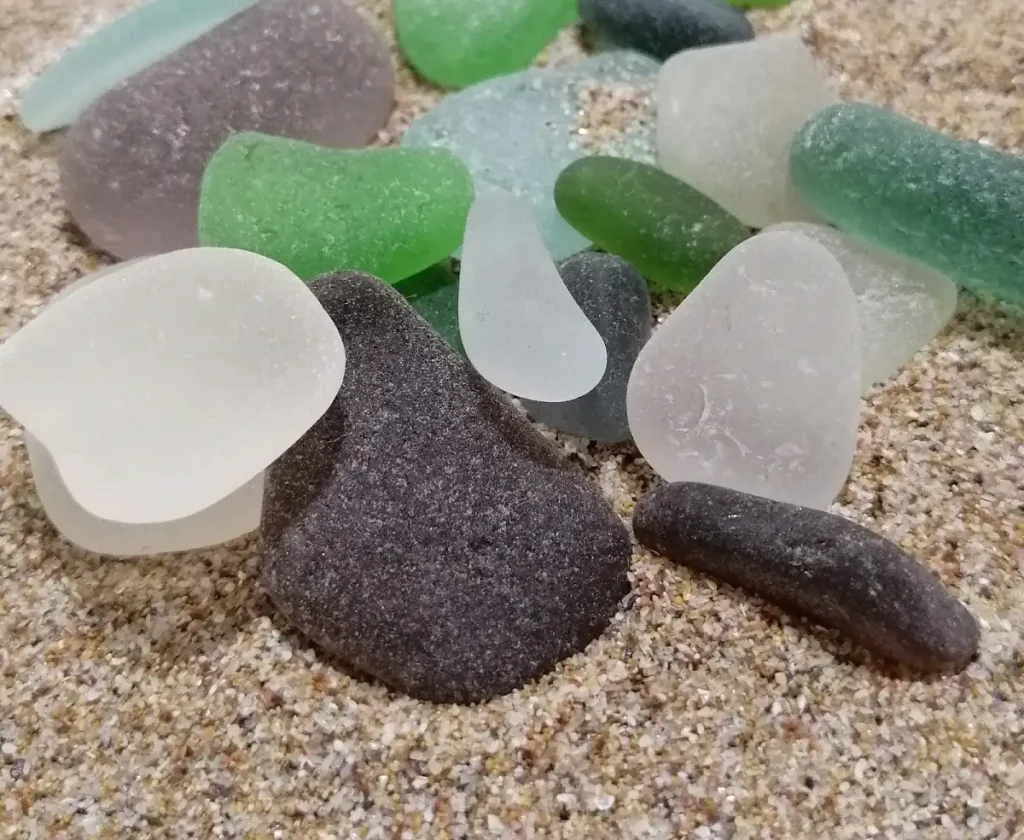
There are things the sea does not keep.
It returns them changed — softened, weathered and almost unrecognizable.
Sea glass is not created intentionally.
It begins as something ordinary: a piece of glass that eventually finds its way into the water. Over time, the sea changes it. Waves, sand and constant movement slowly smooth the surface, soften the edges and remove its original shine.
What remains is not simply glass, but a trace of time. Most pieces are found unexpectedly, without searching for them at all. And perhaps that is part of what makes sea glass feel different — not manufactured or planned, but shaped slowly by the sea over many years.
What Sea Glass Actually Is
Sea glass is ordinary glass that has spent many years in the ocean.
It is not produced or designed this way. It begins as glass that eventually ends up in the sea, where time and movement gradually transform it.
Sharp edges become rounded.
The glossy surface turns soft and matte, almost velvety to the touch. The color remains, but it becomes quieter and deeper.
This process takes years, and sometimes even decades.
That is why genuine sea glass can never be fully recreated artificially. A similar shape can be imitated, but not the time behind it.
And perhaps that is what makes it feel different — it is not simply found, but slowly formed by the sea itself.
How the Sea Changes Glass
The transformation does not happen quickly.
The sea is never in a hurry.
Glass enters the water gradually — sometimes accidentally, sometimes through years of human activity along the coast. And then the slow process begins.
Every wave moves the glass slightly. Forward and back through sand, stones and currents. It turns, collides, rubs against other surfaces and changes little by little over time.
The edges soften first.
Then the surface begins to change more deeply. The original shine disappears and is replaced by a soft frosted texture created through thousands of small movements repeated over many years.
Sand plays its part as well.
Not harshly, but constantly.
Each small abrasion leaves almost no visible mark on its own, yet together they completely change the feeling of the material.
And perhaps that is why sea glass feels quieter somehow.
Not because it has lost something, but because time has softened it into a different form.
Why Every Piece Is Different
No two pieces of sea glass are ever completely identical.
Even pieces with similar colors carry different shapes, textures and traces of movement.
The reason is simple: every piece has followed a different path.
Some spent years moving between stones and became smoother and more rounded. Others remained in calmer water and kept more of their original shape. Some were shaped by stronger tides, others by gentler currents.
Even the beach itself matters.
Different coastlines, sand and water movement leave different marks on the glass.
The colors tell stories too.
White, green and brown pieces are the most common, often originating from bottles and everyday glass containers. Rarer colors like deep blue, turquoise or red are harder to find because they came from more unusual objects.
All of this means that sea glass can never be perfectly repeated.
Even when two pieces appear similar, each carries its own history, time and movement.
And perhaps that is why people are drawn to it — not because it is perfect, but because it is not identical.
Is There Artificial Sea Glass?
As sea glass has become more popular over the years, artificial versions have appeared more often as well.
These are pieces of glass that have been mechanically altered to resemble genuine sea glass, usually with frosted surfaces and rounded edges. The process is much faster and more controlled, but the result only imitates what the sea creates naturally over time.
At first glance, the difference may not always be obvious.
The colors and shapes can appear similar.
But behind them is a completely different process.
Real sea glass changes slowly through years of movement, friction and exposure to natural conditions. Artificially altered glass reaches a similar appearance quickly, without passing through the same environment.
And although they may look alike, they rarely feel the same.
The difference is not only in appearance, but in the path that brought them there.
How to Recognize Genuine Sea Glass
The easiest way to recognize genuine sea glass is not through strict rules, but through attention to detail.
Real sea glass rarely looks perfectly uniform.
Its surface usually carries a fine texture created by years of contact with water, sand and stone. Under close light, small irregularities and natural variations often become visible.
The edges are rounded, but not evenly shaped.
There is no perfect symmetry or repetition. The shape follows the natural movement of the sea rather than a controlled process.
The surface has a soft, muted glow.
Genuine sea glass diffuses light instead of reflecting it sharply. Artificial pieces often remain slightly smoother or shinier.
Sometimes small traces of the original glass still remain — faint lines, bubbles or subtle color variations hidden beneath the frosted surface.
Over time, these differences become easier to notice.
Not simply as a checklist, but as an overall feeling.
And perhaps that is the clearest sign of all — whether the glass feels artificially finished, or truly shaped by the sea.
Where Sea Glass Is Found
Sea glass is usually found where the sea has enough time and movement to shape it.
Rocky beaches and coarse sand coastlines are often the best places to look. Constant movement keeps the glass in motion, allowing it to slowly change over many years.
Not every beach offers the same discoveries.
Some places hold far more sea glass than others depending on tides, currents and what has entered the water over time.
After storms, new pieces often appear.
Waves shift sand and stones, uncovering objects that may have remained hidden for years.
The colors vary as well.
White, green and brown are the most common. Rarer shades like blue, turquoise or red appear less often and usually attract more attention.
But searching for sea glass is not only about finding something.
It is also about slowing down.
Walking more slowly. Looking more carefully. Accepting that some days you may not find anything at all.
And perhaps that is part of what makes it meaningful — it cannot be fully planned.
Sea Glass as Jewelry
When sea glass becomes jewelry, it does not lose what it has already been through.
Its shape remains the same. It is not corrected or perfected.
The only thing added is a way to wear it.
And perhaps that is what makes it feel different from many other kinds of jewelry.
Sea glass does not begin as an ornament.
First it was something ordinary. Then it became part of the sea. Only much later does it become something a person chooses to wear and keep.
Every piece carries its own color, shape and history.
No two are ever completely alike.
And perhaps that is what makes them feel closer to something real — not created to be flawless, but simply shaped by time into what they became.
At Near the Land, we choose such pieces carefully — not only for their appearance, but for the feeling they carry.
Sometimes when holding a piece of sea glass, there is a sense that it has already spent enough time exactly where it needed to be.
Sea glass is never created according to a plan.
It is not always found when searched for.
Sometimes it simply appears — among stones, sand and other traces left by the sea.
And perhaps that is what makes it feel so different.
Not made, but found. Not rushed, but slowly allowed to become what it is.